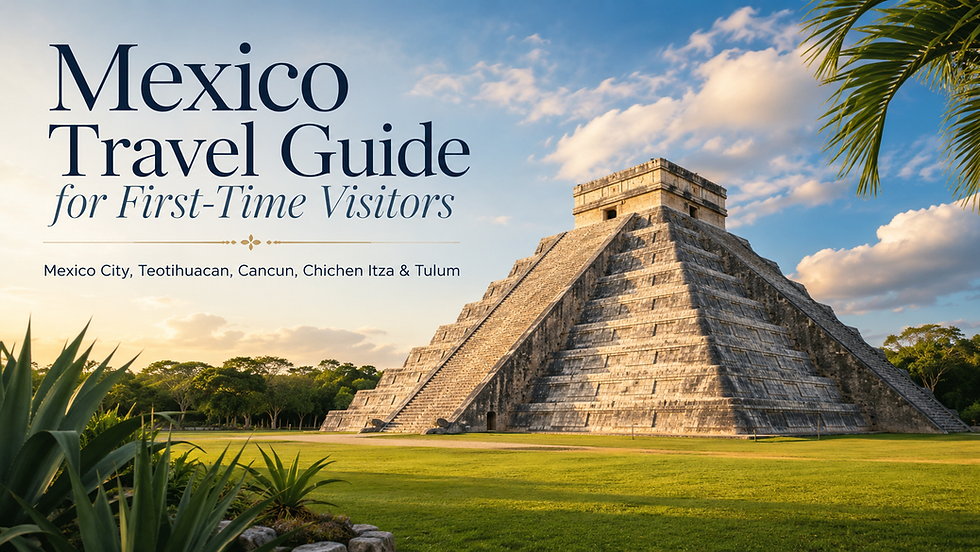
Mexico City and Teotihuacan Travel Diary: My First Time in Mexico as a Filipino Traveler
Aug 2, 2018
11 min read
Updated: Jun 14
In April 2018, I arrived in Mexico with a Filipino passport, a newly approved US visa, and the kind of nervous excitement that only a first international adventure can give you.
Mexico was not just another destination for me. It felt like a door opening.
As a Filipino traveler, I knew that having a weak passport meant every trip required more preparation, more documents, and more courage. But once I had my US visa, suddenly the map of the Americas felt a little more reachable. Mexico became one of the first places where I truly felt that travel could be bigger than fear.
This is my Mexico City and Teotihuacan travel diary — a memory of ancient ruins, colonial streets, grand architecture, and that unforgettable feeling of finally standing somewhere I used to only see in photos.
About Mexico for First-Time Travelers
Mexico is one of the most fascinating countries in North America, known for its ancient civilizations, colorful cities, dramatic landscapes, powerful traditions, and world-famous food. For many first-time travelers, it offers a beautiful mix of history, culture, beaches, architecture, street life, and adventure.
Mexico City, the capital, is one of the best places to begin because it feels like many worlds layered together. You can walk through colonial plazas, see Aztec history, admire grand European-inspired buildings, eat tacos from a busy street stand, and visit museums and ruins that tell stories from long before modern Mexico existed.
The country is especially famous for its archaeological sites, Mexican cuisine, Día de los Muertos traditions, mariachi music, cenotes, beaches, deserts, colorful towns, and warm cultural energy. It is a place where the past does not feel hidden. It is still alive in the streets, the food, the buildings, and the way people gather.
For a nervous first-time traveler, Mexico can feel intense at first because the cities are big, busy, and full of movement. But it can also feel deeply rewarding. It is a destination that teaches you to observe, slow down, and allow yourself to be surprised.
Arriving in Mexico: The Start of My Mexico City and Teotihuacan Travel Diary
My journey started from the Caribbean, where I was living and working at the time. I flew first to Miami and stayed there for one night before continuing to Mexico City the next day.
I still remember the feeling of that flight.
There was excitement, but also a small fear inside me. This was one of those trips where I was not just visiting a place. I was testing myself. I was asking whether I could really travel farther, plan better, and handle a bigger journey on my own.
When the plane landed in Mexico City, I felt that familiar rush every traveler knows — the moment the aircraft doors open and the air of a new country enters your life.
Mexico felt warm, alive, and full of energy. Even before I understood the city, I could feel that it had history. The streets, the sounds, the food, and the people carried a rhythm that was different from anywhere I had been before.
For me, that arrival was more than a stamp or a flight completed. It was the beginning of a new confidence.
First Impressions of Mexico City
Mexico City immediately felt huge.
It was not the kind of city you understand in one day. It was layered, crowded, historic, artistic, and constantly moving. There were colonial buildings, modern towers, wide plazas, old churches, street vendors, traffic, music, and people everywhere.
As an architect, I was drawn to the buildings almost instantly. Mexico City felt like a living museum, but not in a quiet or frozen way. Its history was mixed with everyday life.
People were walking to work. Vendors were selling food. Tourists were taking photos. Locals were crossing the plaza like it was just another normal day. And in the middle of it all, these massive historic buildings stood with so much dignity.
That contrast stayed with me.
Some cities hide their past behind modern life. Mexico City places the past right in front of you.
Mexico City and Teotihuacan Travel Diary: Exploring the Historic Center
For my first full day, I joined a guided city tour that took me through the historic center of Mexico City. I was with a local guide and a small group, which made the experience easier and less overwhelming.
For first-time travelers, I really think guided tours can help, especially in large cities. When you are new to a place, you do not always know what you are looking at. A guide gives meaning to the buildings, the streets, and the stories behind them.
We walked through the colonial heart of the city, where cobblestone streets and grand buildings made the past feel close. The architecture was beautiful, but what made it powerful was the way it connected different periods of Mexican history.
There were Spanish colonial influences, government buildings, churches, plazas, and traces of older civilizations beneath the surface.
I remember standing in the Zócalo, Mexico City’s main public square, and feeling small in the best possible way.
The space was massive. The flag was enormous. The buildings around it felt formal and symbolic. It was one of those places where you do not need to understand every historical detail to feel that something important happened there.
The Metropolitan Cathedral and the Power of Old Architecture
One of the most impressive landmarks I saw was the Mexico City Metropolitan Cathedral.
Its size, details, and presence were unforgettable. The cathedral stood beside the Zócalo with a kind of quiet power. It was not just beautiful because it was old. It was beautiful because it carried centuries of faith, design, construction, and survival.

As someone trained in architecture, I found myself looking closely at the façade, the proportions, the details, and the way different styles appeared together. Buildings like this remind me that architecture is never only about walls and decoration. It is about history, power, belief, and identity.
The cathedral’s mix of styles gave it character. It did not feel like something designed in one moment.
It felt like something shaped over time.
That is what made it interesting to me.
Some buildings impress you because they are perfect. Others impress you because they have lived.
Palacio de Bellas Artes: A Building I Could Not Stop Looking At
Another highlight of the city tour was Palacio de Bellas Artes.
This was one of the buildings that truly captured me. Even now, when I think about Mexico City, this landmark is one of the first images that comes back to my mind.
The exterior had elegance and drama. The curves, the details, the stone, and the overall composition felt grand but artistic. It was not just a building. It felt like a performance before you even entered it.
As an architect, I was fascinated by the way it blended different design influences. The outside had a classical and Art Nouveau feeling, while the interior is known for its Art Deco character. That mixture gave the building a unique personality.
It reminded me why I love traveling as an architect.
Travel does not only show you places. It trains your eyes. It makes you notice proportions, materials, light, public spaces, and how people interact with architecture. Palacio de Bellas Artes was one of those places where I felt both like a tourist and a student again.
Seeing the Modern Side of Mexico City
As the tour continued, I also saw another side of Mexico City — the modern one.
Beyond the colonial streets and historic buildings, the city opened into busy roads, modern structures, commercial areas, and a faster rhythm. This contrast made Mexico City more interesting to me.
It was not only a historical destination. It was a living capital.
The city seemed to carry many identities at once. Ancient, colonial, artistic, modern, chaotic, elegant, and everyday. That is what made it feel real.
By the end of the day, I felt tired but deeply fulfilled. I had only seen a small part of the city, but it had already given me so much to think about.
My Day Trip to Teotihuacan
The next day, my Mexico City and Teotihuacan travel diary continued with one of the places I was most excited to see: Teotihuacan.
I had seen photos of the pyramids before, but photos never fully prepare you for the feeling of standing in front of ancient structures that have survived for centuries.
When I arrived, the first thing that struck me was the scale.
The pyramids rose from the open landscape with a quiet strength. The site felt vast, mysterious, and almost unreal. It was not like walking into a museum where history is behind glass. It was open, physical, and powerful.
You could walk through it. You could feel the sun, the wind, the stone, and the distance between each structure.
It made history feel less like information and more like presence.
Walking Through the Ancient City
Teotihuacan is one of those places that makes you slow down.
As I walked through the archaeological site, I imagined what the ancient city might have looked like when it was alive. People walking along the avenues. Ceremonies taking place. Families living nearby. Builders, planners, artisans, and leaders creating something far bigger than themselves.
The Avenue of the Dead gave the site a strong sense of direction. It was not random. It was planned.
It had order, meaning, and intention.
That is what fascinated me most.
As an architect, I could not help but think about the planning behind it. The scale of the pyramids, the alignment of spaces, and the relationship between structures showed a level of organization that still feels impressive today.
Travel moments like this make you humble. You realize that the people who came before us were not primitive or simple. They were builders, thinkers, observers, and creators.

The Pyramid of the Sun
The Pyramid of the Sun was one of the most unforgettable parts of Teotihuacan.
Standing near it, I felt the weight of its size. It did not need to be decorated to feel powerful. Its mass alone was enough.
Climbing the steps was not just physical. It felt symbolic. Every step made me more aware of where I was. The higher I went, the more the site opened around me.
From above, I could see the layout of Teotihuacan more clearly. The Avenue of the Dead stretched across the landscape, and the surrounding structures formed a pattern that felt intentional and sacred.
I remember pausing there, looking out, and feeling grateful that I had made it this far.
For a Filipino traveler who once felt limited by passport restrictions, standing on an ancient pyramid in Mexico felt almost unbelievable.
The Pyramid of the Moon and the Mystery of the Past
The Pyramid of the Moon had a different feeling.
It felt quieter, more ceremonial, and more mysterious. Standing near it, I imagined the rituals and gatherings that may have happened there. The site carried a kind of silence that made you think.
There are places that are beautiful because of what you see.
Teotihuacan was powerful because of what you cannot fully know.
You can read about its history. You can listen to a guide explain its culture. You can study the structures and the archaeological findings. But there will always be something unknowable about it.
That mystery is part of its beauty.
When in Teotihuacan When in Teotihuacan When in Teotihuacan
What Teotihuacan Taught Me
Teotihuacan reminded me that travel is not only about sightseeing.
Sometimes, travel is about being confronted by time.
In a place like this, your own life feels very small. Your worries, your plans, your fears, and your routines become tiny compared with the centuries beneath your feet.
But strangely, that does not feel sad. It feels freeing.
It reminded me that humans have always dreamed, built, worshipped, gathered, and tried to leave something behind. The people of Teotihuacan lived in a different world from ours, but their city still speaks.
As I walked away from the pyramids, I carried a deep respect for the ancient builders who created them. Their work survived not just as ruins, but as a reminder of imagination, discipline, and belief.

Practical Reflections for First-Time Travelers Visiting Mexico City and Teotihuacan
Looking back, I think Mexico City and Teotihuacan are a powerful combination for first-time visitors to Mexico.
Mexico City gives you culture, architecture, food, street life, museums, plazas, and modern energy. Teotihuacan gives you space, silence, ancient history, and a deeper sense of wonder.
For nervous travelers, joining a guided tour can make the experience easier. It helps with transportation, context, timing, and understanding what you are seeing. This is especially helpful if you are visiting Teotihuacan as a day trip from Mexico City.
Wear comfortable shoes, bring water, check the weather, and prepare for open walking areas. The site can feel exposed depending on the season. During my visit, the weather felt chilly, which reminded me that Mexico is not always the tropical image people imagine.
Mexico has many climates, and Mexico City sits at a high elevation. First-time travelers should not assume it will always be beach weather.
A Personal Note on Traveling with a Filipino Passport
This trip meant a lot to me because I was traveling with a Filipino passport.
Many people with strong passports may not understand how emotional a trip can feel when you are used to visa applications, extra questions, proof of funds, and entry requirements. For weak-passport travelers, every successful journey can feel like proof that the world is still possible.
Having a US visa helped me open this route, but the courage to go still had to come from me.
That is what I remember most from Mexico.
Not just the buildings. Not just the pyramids. Not just the food or the photos.
I remember the feeling of becoming braver.
Final Thoughts: Why This Mexico City and Teotihuacan Travel Diary Still Matters to Me
My first days in Mexico gave me a kind of travel confidence I did not know I needed.
Mexico City showed me the beauty of a capital that carries history in its streets. The Zócalo, the Metropolitan Cathedral, Palacio de Bellas Artes, and the colonial center reminded me how architecture can hold memory. Teotihuacan showed me something even older — a civilization whose ruins still speak through stone, space, and silence.
This Mexico City and Teotihuacan travel diary is not just about where I went. It is about what the journey awakened in me.
It reminded me that even if your passport makes travel harder, it does not make your dreams smaller.
Sometimes, all it takes is one trip to prove to yourself that the world is not as unreachable as it once seemed.
And for me, Mexico was one of those trips.
Frequently Asked Questions About Visiting Mexico City and Teotihuacan
Is Mexico City good for first-time travelers?
Yes, Mexico City can be a great destination for first-time travelers who enjoy culture, food, architecture, museums, and history. It is a big and busy city, so planning your areas, tours, transportation, and daily route can make the experience easier.
Can Teotihuacan be visited as a day trip from Mexico City?
Yes. Teotihuacan is commonly visited as a day trip from Mexico City. Many travelers join guided tours because transportation and historical context are easier that way.
What is Teotihuacan known for?
Teotihuacan is known for its ancient pyramids, especially the Pyramid of the Sun and Pyramid of the Moon, as well as the Avenue of the Dead. It is one of Mexico’s most important archaeological sites.
Is Mexico City only about old buildings and ruins?
No. Mexico City has a mix of ancient history, colonial architecture, modern neighborhoods, museums, food markets, parks, nightlife, and contemporary culture. That mix is what makes it so interesting.
What should I bring for a Teotihuacan day trip?
Comfortable shoes, water, sun protection, a light jacket depending on the season, and a camera are useful. The site involves walking in open areas, so it is better to prepare for changing weather.
Is this diary a full Mexico itinerary?
No. This is Part 1 of my Mexico travel diary, focused on Mexico City and Teotihuacan. The journey continues toward Cancun and the Yucatán Peninsula in the next part.