
Peru Travel Diary: Rainbow Mountain, Cusco to Puno, and My Last Days in Peru
Apr 15, 2023
12 min read
Updated: Jun 12
Some travel days feel like a destination. Others feel like a transition.
But this part of my Peru journey felt like both.
After the unforgettable road to Machu Picchu, my body was tired, my legs were sore, and my mind was still somewhere in the clouds above the ancient Inca ruins. But Peru was not finished with me yet. There was still one more mountain waiting near Cusco, one more high-altitude challenge, and one more long road that would slowly carry me toward Lake Titicaca and the border of Bolivia.
This is my Peru travel diary from Rainbow Mountain to Puno — a personal chapter from my first South America journey, where I learned that Peru is not only about famous places. It is also about early mornings, thin air, quiet bus rides, local strength, and the emotional feeling of slowly leaving a country that gave you more than you expected.
For the complete route before this part of the journey, you can read my <u>Peru travel guide for first timers</u>, where I share how I planned my Lima, Huacachina, Cusco, Machu Picchu, Rainbow Mountain, and Puno itinerary.
Rainbow Mountain from Cusco: One More High-Altitude Adventure
By the time Rainbow Mountain came into my itinerary, I had already experienced one of the biggest highlights of my life: Machu Picchu.
My body knew it.
My legs were still carrying the memory of the trek. My energy was not as fresh as it had been at the beginning of the trip. But when you are already in Cusco, and Rainbow Mountain is within reach, there is a part of you that says: how can I leave Peru without seeing it?
So I went.
The pickup was painfully early — around 3:30 AM. Cusco was still dark, quiet, and cold when the van arrived. Inside were other travelers who looked just as sleepy but also strangely excited. That is one of the funny things about travel. Sometimes you wake up at an hour you would never accept at home, but because you are chasing a mountain, it suddenly feels worth it.
We drove through the darkness toward the Andean countryside. Eventually, the day began to open. The road revealed small towns, wide landscapes, and the kind of mountain scenery that reminds you how far you are from your normal life.
For early morning tours like Rainbow Mountain, having mobile data can make the day less stressful — from checking pickup messages to using maps, contacting your tour operator, or updating family while you are far from the city.
We stopped for breakfast in Quiquijana before continuing toward the trailhead area. It was simple, but at that hour and altitude, even a basic meal felt important. I knew the hike would not be easy, especially after the physical days I had already gone through.
If you are planning this trip yourself, I wrote a separate practical guide on how to visit Rainbow Mountain from Cusco, including the tour options, horse or mule ride, difficulty, what to bring, and what first-time travelers should expect.
The Hike to Rainbow Mountain
When we finally reached the starting area, the reality of the hike became clearer.
Rainbow Mountain is not only about distance. It is about altitude. The air feels different. Your breathing changes. Even if the trail looks manageable in photos, your body may react in ways you do not expect.
Before starting the trek, we were given a choice: walk the trail or take a mule or horse for part of the way with the help of local handlers.
I decided to walk.
But I still remember the local mule handlers clearly. Many of them were elderly women wearing colorful traditional clothing, guiding the animals with a confidence that amazed me. The same mountain that made many travelers pause for breath seemed like part of their everyday life. Watching them move across that difficult terrain with such strength gave me a deeper respect for the people who live and work in the Andes.
“Rainbow Mountain taught me that packing is not just about clothes. At high altitude, small things like warm layers, gloves, water, snacks, sunscreen, lip balm, and trekking poles can completely change how comfortable the day feels.”
The hike was slow. I had my trekking poles with me, and they helped. Every few steps, I would stop, breathe, look around, and continue.
The scenery was raw and powerful. Snowy peaks stood in the distance. Wide valleys opened around us. Llamas and alpacas appeared along the trail. The land felt rugged, cold, and alive. This was not the polished version of travel that you see in postcards. It was real, windy, exhausting, and beautiful.
There were small stops along the way, including a place where travelers could get a Rainbow Mountain passport stamp. It was a small souvenir, but it added something memorable to the day — like proof that you had pushed yourself to reach this strange and colorful corner of Peru.
Reaching the Rainbow Mountain Viewpoint
The final push was the hardest.
At around 5,036 meters above sea level, every movement felt heavier. It was not only my legs working. It was my lungs, my patience, and my willpower.
And then, slowly, the famous colors appeared.
Rainbow Mountain, or Vinicunca, looked almost unreal. Stripes of red, yellow, green, brown, and muted earth tones stretched across the slopes. Behind it, the powerful presence of Ausangate Mountain made the scene feel even more dramatic.
Photos can show the colors, but they cannot fully explain the feeling of standing there after the climb.
There was tiredness, yes. But there was also silence inside me. The kind of silence that comes when nature is too big for words.
Decorated llamas stood nearby for photos. Travelers smiled, posed, rested, and tried to absorb the view. Some were clearly struggling from the altitude, while others looked emotional, as if the mountain had pulled something out of them.

For me, Rainbow Mountain was not only about reaching a viewpoint. It was about realizing that some places demand effort before they reveal themselves.
And maybe that is why they stay with us longer.
“High-altitude trips remind you that travel can be beautiful and unpredictable at the same time. Even when everything goes well, it is comforting to know you have protection if altitude sickness, delays, accidents, or unexpected problems happen far from home.”
Returning to Cusco After Rainbow Mountain
The descent felt easier, but my body was already exhausted.
After the hike, we returned for lunch at the same area where our day had started. Food tasted better after the cold, the altitude, and the effort. Everyone seemed quieter on the way back, as if the mountain had taken our energy but left something peaceful in its place.
By around 4:30 PM, we were back in Cusco near Plaza Regocijo.
I walked back to my hotel with that familiar travel feeling — tired, dusty, grateful, and slightly amazed that the day had actually happened.
Rainbow Mountain was not the easiest thing I did in Peru. But it was one of those experiences that made the country feel bigger than my expectations.
Machu Picchu had shown me the genius of ancient architecture and civilization. Rainbow Mountain showed me the raw force of the Andes.
Together, they made my time in Cusco unforgettable. If you want to read the chapter before this one, you can continue through my Cusco and Machu Picchu diary, where I share the journey that led me to one of the most emotional moments of my Peru trip.
A Slow Day in Cusco Before Leaving for Puno
The next day, December 30, felt different.
After days of movement, hiking, and early starts, Cusco felt like a place asking me to slow down before saying goodbye.
I wandered through the city again, letting myself enjoy it without rushing. Cusco is one of those cities where even a simple walk feels layered. The stone streets, old walls, churches, plazas, and surrounding mountains all seem to carry history.
That day, I also tried cuy, or roasted guinea pig, one of Peru’s well-known traditional dishes. I had read about it before my trip, and since I was already in Peru, I felt I had to experience it at least once.
Travel is not only about seeing places. Sometimes it is also about allowing yourself to taste something unfamiliar, even if you are unsure whether you will love it.
Later, I visited the Museo de Arte Precolombino, a museum filled with ancient artifacts, pottery, jewelry, and pieces that helped me understand Peru beyond the landscapes. The lighting, the old colonial setting, and the quiet displays made it feel reflective. It was not just a museum stop. It felt like a pause before leaving Cusco.
As an architecture-minded traveler, I always find myself looking at old buildings, stonework, and preserved spaces differently. In Cusco, history is not hidden. It is built into the walls.
A Cusco City Tour Before the Overnight Bus
Since my bus to Puno was not until later that evening, I still had time for one more small adventure.
While walking around the city, I noticed a sign for a half-day Cusco city tour. It felt spontaneous, but it also felt right. My time in Cusco was almost over, and I wanted one last view of the city before moving on.
The tour started near the main plaza. A double-decker bus took us through the streets and toward higher viewpoints. It rained lightly, but somehow the drizzle made the city feel even more dramatic.
We passed important landmarks and saw parts of the city from a different angle. One of the highlights was seeing the archaeological area of Saqsaywaman from the bus. Even from a distance, it reminded me again of how deeply the Inca legacy shapes this region.
There were also cultural moments along the way, including a demonstration involving coca leaves, which are deeply connected to Andean traditions. Nearby stalls displayed woolen crafts, local textiles, and souvenirs.
But the moment that stayed with me most was the view of Cusco from above.
The statue of Christ overlooking the city, the purple-blue evening sky, the lights beginning to glow, and the rain falling softly around us — it felt like Cusco was giving me one final memory before I left.
By the time we returned to the city center, darkness had settled. The cathedral glowed in the plaza, and I felt that bittersweet feeling travelers know too well.

I was ready for the next destination.
But I was not fully ready to leave.
Overnight Bus from Cusco to Puno
Later that night, I made my way to the bus departure area for my overnight journey to Puno.
The taxi ride to Avenue Alameda cost me around 3 USD at the time. From there, I met the Peru Hop representative and prepared for the next leg of the trip.
This was my first-ever overnight bus journey, and I remember feeling both curious and slightly nervous. Overnight buses are part of backpacking life in South America, but when it is your first time, there is always that small question in your mind: Will I sleep? Will my bags be okay? Will I know where to get off?
Thankfully, the bus was comfortable. The seats were soft enough to rest, and the rhythm of the road slowly pulled me into sleep.
Outside, Peru continued to change in the darkness.
Inside, I sat with my thoughts.
Cusco was behind me. Puno was ahead. And somewhere beyond Puno, Bolivia was already waiting.
This is what I love about overland travel. You do not just teleport from one destination to another. You feel the distance. You feel the transition. You wake up in a different place with the memory of the road still inside you.
“Long travel days are easier when you have the basics ready: offline maps, translation apps, booking confirmations, ride apps, a power bank, and copies of important documents saved on your phone.”
Arriving in Puno and Seeing Lake Titicaca
Morning arrived softly in Puno.
The city felt different from Cusco. It was quieter, colder, and more connected to the vast presence of Lake Titicaca. After arriving, a shuttle organized through Peru Hop brought me to my accommodation, Suite Independencia.
The hotel felt simple and warm, and the early check-in helped a lot after the overnight bus. What I remember most was the kindness of the hosts and the roof deck view. From there, I could see Puno stretching toward Lake Titicaca.
There was something calming about that view.
After the intensity of Lima, Huacachina, Cusco, Machu Picchu, and Rainbow Mountain, Puno felt like a place for reflection. It was my final stop in Peru, and I could feel the journey slowing down.
On New Year’s Eve, fireworks lit up the sky over the city. From the roof deck, with the lake in the distance, I felt grateful in a quiet way.
I had made it this far.
Peru had challenged me, surprised me, tired me, and rewarded me.
Visiting the Uros Floating Islands on Lake Titicaca
One of the highlights of Puno was visiting the Uros Floating Islands.
Lake Titicaca already felt impressive from the city, but being on the water made it feel even more powerful. The lake stretched endlessly, wide and blue, carrying stories that felt older than anything I could fully understand.
From the dock, we boarded a boat and headed toward Uros. The air was crisp, and the water reflected the sky in a way that made the journey feel calm and almost dreamlike.
The Uros Islands are man-made floating islands built from reeds. I had heard about them before, but seeing them in person was different. The homes, boats, and even the ground beneath our feet were made from reeds.
It was fascinating and humbling.
The people welcomed us with warmth, wearing colorful clothing that stood out beautifully against the soft neutral tones of the reed structures. During the visit, we learned how the islands are built and maintained, and how life continues on this floating community.
It made me think about adaptation.
People can build homes on water. They can create culture from what nature gives them. They can live in ways that seem impossible to outsiders but completely natural to them.
That is one of the gifts of travel. It reminds you that your version of normal is only one version.
My Last Night in Peru
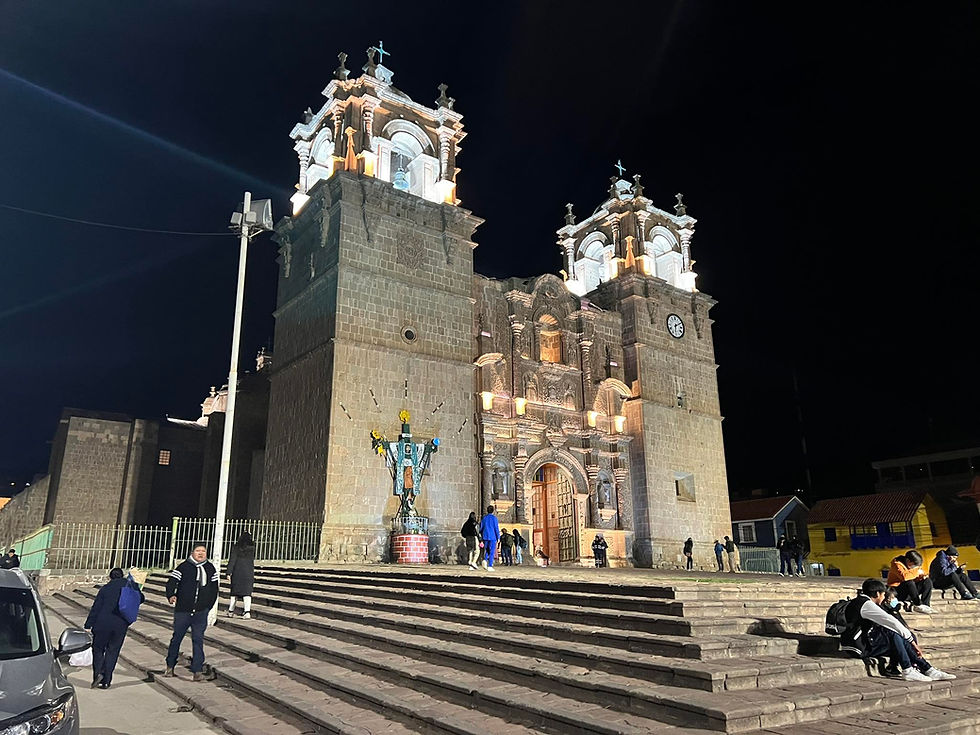
That evening in Puno, I walked near the Lake Titicaca sign and around the plaza. The city had a gentle charm, especially at night.
I had dinner near the cathedral, in a small restaurant where the atmosphere was warm and comfortable. The staff spoke English, which made the experience easier. From my table, I could admire the architecture of the cathedral, glowing under the night sky.
It was not a dramatic final night.
It was quiet.
And maybe that was exactly what I needed.
After so many intense travel days, my last night in Peru felt like a soft closing page. I returned to my room knowing that the next morning would begin a new chapter: crossing from Peru into Bolivia.
For travelers following a similar route, this part of the journey connects naturally with my border crossing and Copacabana Bolivia diary, where I share what it felt like to leave Peru by land and arrive in Copacabana on the Bolivian side of Lake Titicaca.
Final Thoughts: What This Part of Peru Taught Me
This part of my Peru journey was not only about seeing Rainbow Mountain or reaching Puno.
It was about endurance.
It was about learning how travel feels when your body is tired but your spirit is still curious. It was about standing at 5,036 meters and realizing how small you are. It was about watching local women guide mules through the Andes with strength and grace. It was about leaving Cusco slowly, riding through the night, waking up near Lake Titicaca, and understanding that every ending in travel is also a doorway.
Peru gave me famous places, yes.
But it also gave me quieter memories: a cold morning van ride, a rooftop in Puno, fireworks over the lake, a dinner beside the cathedral, and the feeling of packing my bag for the next country.
By the end of this chapter, I was no longer only thinking about Peru as a destination.
I was thinking about it as a journey that had changed the way I saw South America.
“In places like Peru, small expenses add up quickly — taxis, meals, tips, entrance fees, snacks, and last-minute transport. Having a simple way to manage travel money and avoid unnecessary currency stress makes the journey feel smoother.”
And as I prepared to leave for Bolivia, I carried one thought with me:
Some countries do not simply let you visit. They make you grow while passing through them.
FAQs About This Peru Travel Diary from Rainbow Mountain to Puno
Is Rainbow Mountain worth visiting from Cusco?
Yes, Rainbow Mountain is worth visiting if you enjoy dramatic landscapes and are prepared for high altitude. It is physically demanding, but the scenery makes it one of the most memorable day trips from Cusco.
Is Rainbow Mountain difficult?
Rainbow Mountain can feel difficult mainly because of the altitude. Even if the trail does not look extremely technical, the thin air makes the hike harder. It is better to visit after spending time acclimatizing in Cusco.
Can you ride a horse or mule at Rainbow Mountain?
Yes, local handlers usually offer horses or mules for part of the Rainbow Mountain hike. Travelers who struggle with altitude or fatigue may consider this option, but you still need to walk some sections, especially near the final viewpoint.
How early do Rainbow Mountain tours start?
Many Rainbow Mountain tours from Cusco start very early, often around 3:00 to 4:00 AM. My pickup was around 3:30 AM, followed by a breakfast stop before reaching the trail area.
How do you travel from Cusco to Puno?
One common option is an overnight bus from Cusco to Puno. I used Peru Hop during my trip, which helped make the journey more organized as a solo traveler.
Is Puno worth visiting?
Puno is worth visiting if you want to experience Lake Titicaca and the Uros Floating Islands. It also works well as a final Peru stop before crossing into Bolivia by land.
Can you continue from Puno to Bolivia?
Yes. Many travelers continue from Puno to Copacabana, Bolivia by bus, crossing the border near Kasani. This route is especially useful if you are combining Peru and Bolivia in one overland South America trip.


