Peru Travel Diary: Lima to Huacachina, My First Days in South America
Feb 11, 2023
15 min read
Updated: Jun 10
My Peru Travel Diary from Lima to Huacachina
Peru was not just another destination on my travel list. It was the beginning of something bigger.
In December 2022, I found myself preparing for one of the most exciting journeys of my life — a solo trip through South America. For years, I had dreamed of seeing Machu Picchu with my own eyes. As an architecture student, I had once studied and sketched its ancient stone forms, not knowing that one day I would be standing in the same country where that dream began.
But before Cusco, before the Sacred Valley, and before Machu Picchu, my Peru travel diary started somewhere lower, warmer, and closer to the Pacific Ocean: Lima.
This is the story of my first days in Peru — from arriving in Lima after a long flight, exploring Miraflores and the historic center, traveling to Paracas, seeing wildlife along the coast, and ending the day surrounded by the golden dunes of Huacachina.
For first-time travelers, Peru can feel exciting and intimidating at the same time. It is a country of ancient history, dramatic landscapes, busy cities, desert coastlines, mountain towns, and deep cultural identity. My first few days taught me that Peru is not a place you simply visit. It is a place you slowly enter, layer by layer.
About Peru for First-Time Travelers
Before arriving, Peru was one of those countries that felt almost mythical to me. Many travelers know it because of Machu Picchu, but the country is much more than one famous landmark.
Peru is located on the western side of South America, bordered by the Pacific Ocean. Its capital is Lima, a large coastal city known for food, history, colonial architecture, ocean views, and its role as a gateway to the rest of the country.
What makes Peru interesting is its variety. In one trip, you can experience coastal desert, high mountains, ancient ruins, colorful markets, colonial cities, wildlife-rich islands, and some of the most famous food in South America.
The currency is the Peruvian sol. Spanish is the main language, although English is spoken in some tourist areas. For beginner travelers, learning a few Spanish phrases can make a big difference, especially when taking taxis, asking for directions, ordering food, or moving outside major tourist zones.
Peru is also known for ceviche, pisco sour, chifa, alpaca textiles, Inca history, Andean culture, desert landscapes, and high-altitude destinations like Cusco and Machu Picchu.
The climate depends heavily on where you go. Lima and the coast can feel dry and mild, while the Andes can be colder, especially at night. If your trip combines Lima, Huacachina, Cusco, and Machu Picchu, you should pack for different temperatures and travel conditions.
For me, Peru felt like a country of contrasts — ocean and desert, chaos and beauty, ancient history and modern movement. It was the perfect beginning to my South American journey.
Planning My Peru Route as a Solo Traveler
I have always romanticized spontaneous travel — the idea of packing a bag, booking a flight, and letting the road decide everything.
But in reality, I also know myself. I am a dreamer, but I am a planner too.
As a Filipino traveler, and as someone used to thinking carefully about routes, entry rules, budgets, and logistics, I knew I could not simply arrive in Peru without a plan. South America felt big. Peru alone already had so many moving parts: Lima, Paracas, Huacachina, Cusco, Machu Picchu, Rainbow Mountain, and the route onward to Bolivia.
So months before my trip, I started researching.
I looked at transportation, tours, hotels, local costs, safety tips, and how to connect one stop to another without wasting too much time. That was when I found Peru Hop, a bus service that helped connect travelers between major destinations in Peru.
For this part of my trip, Peru Hop made things easier. I did not have to figure out every bus terminal on my own. I could follow a route, understand the scheduled stops, book tours, and plan my accommodation around the journey.
As a solo traveler, that convenience mattered.
It gave me enough structure to feel safe, but enough freedom to still feel like I was traveling independently.
Arriving in Lima: My First Night in Peru
After nearly 10 hours of travel, with layovers in Miami and Medellín, I finally arrived at Jorge Chávez International Airport in Lima.
It was around 2 AM.
That moment felt strange in the way only late-night arrivals can feel. You are tired, slightly disoriented, carrying your bags, checking your documents, and trying to look confident even when everything around you is unfamiliar.
I had a backpack and a small trolley bag with me. Nothing too excessive, but enough to remind me that I was far from home and at the beginning of a long journey.
At that hour, I chose convenience over adventure. Instead of trying to figure out public transportation, I went to the airport taxi booking area. I spoke with the taxi representative, paid the fare, and was escorted to the car.
Thankfully, English helped during that first interaction.
The drive through Lima at night was quiet but atmospheric. The city slowly revealed itself through streetlights, empty roads, and the feeling of arriving somewhere completely new.
When the taxi finally pulled up at San Agustin Exclusive Hotel in Miraflores, I felt relieved.
I had made it.
There is a special kind of comfort in reaching your hotel after a long travel day. The trip is not truly real until you enter your room, put your bags down, and finally allow your body to rest.
That night, I fell asleep knowing that my first morning in Peru was waiting.
Waking Up in Miraflores
My first full day in Peru began in Miraflores, one of Lima’s most popular areas for visitors.
Miraflores felt like a gentle introduction to the country. It was modern, walkable in many areas, close to the ocean, and filled with cafes, shops, hotels, restaurants, and travelers. For a first-time visitor, it felt like a practical base.
Near my hotel, I found a small 24-hour convenience store. It sounds simple, but those little discoveries matter when you are traveling. Knowing where to buy water, snacks, or small essentials gives you a sense of comfort in a new place.
Not far from the hotel was Larcomar, a cliffside shopping center overlooking the Pacific Ocean.
This was one of my first beautiful impressions of Lima.

The mall itself was modern, but the real highlight was the view: the ocean below, the coastline stretching into the distance, the road curving beneath the cliffs, and the Pacific breeze reminding me that Lima is not just a capital city — it is a coastal city with its own rhythm.
I spent time walking, observing, and slowly settling into the reality that I was finally in South America.
Exploring Lima’s Historic Center
Later that day, I joined a city tour from the tourist visitor center near Miraflores. One of the reasons I chose my hotel was because it was conveniently located near the Peru Hop stop and visitor center.
The tour began in the afternoon. Our guide led us through public transport and into the heart of Lima.
The mood changed as we moved from Miraflores toward the historic center. Lima became louder, busier, older, and more layered.
We visited areas around Parque Neptuno, the Palace of Justice, Plaza San Martín, and the historic center. As someone with an architecture background, this part of Lima immediately caught my attention.
The buildings had presence.
The facades, balconies, churches, plazas, and colonial details told stories of power, religion, history, and identity. Lima’s historic center felt like a place where the past was not hidden away. It was still standing, still visible, still part of everyday life.
One of the most memorable sights was Lima Cathedral, with its grand exterior and religious importance. The Archbishop’s Palace and the Presidential Palace also stood out, especially with their historic architectural character.

But what made the experience more real was the atmosphere around it.
There were street vendors, local people, tourists, police officers, movement, noise, and life everywhere. Peru at that time was also facing political unrest, and there was uncertainty around travel plans, especially for those hoping to visit Machu Picchu. I remember feeling a slight worry in the background.
Would my dream destination still be possible?
At that moment, I reminded myself to stay present. I was already in Peru. I was already experiencing something meaningful.
Sometimes travel teaches you to hold excitement and uncertainty at the same time.
Churros, Chinatown, and Chifa
One of the small joys of that day was food.
As we walked through the city, I noticed the smell of churros. Warm, sweet, simple, and comforting — the kind of street snack that feels even better when you are walking through a new city.

After the tour, I joined some fellow travelers and we wandered toward Lima’s Chinatown. This was where I first experienced chifa, the Peruvian-Chinese fusion cuisine that is popular in Peru.
I loved this part because it reminded me how travel is not only about landmarks. Sometimes, the best memories come from following people you just met, walking through a busy street, trying something local, and realizing that culture is often found around the table.
The journey back to Miraflores was not completely effortless. Not everyone spoke English, and we had to navigate our way using basic Spanish, observation, and a little patience.
That day taught me one of my most practical Peru lessons: learn a little Spanish.
You do not need to be fluent. But even simple words can help you ask questions, understand directions, buy food, and feel less helpless when you are outside the most tourist-friendly areas.
Personal Tips from My First Day in Lima
Lima is a good introduction to Peru, but first-time travelers should still stay aware and practical.
Keep your belongings close, especially in crowded streets, public transport, markets, and busy tourist areas. My guide reminded us more than once to watch out for pickpockets.
Carry small cash for tips, snacks, transport, and small purchases. A little cash is useful when visiting markets or joining local tours.
Stay in a convenient area if you are arriving late or joining an early tour. For me, Miraflores worked well because it felt comfortable, had many services nearby, and made my Peru Hop logistics easier.
Do not underestimate Lima. Many travelers treat it only as a transit city before Cusco, but my first day showed me that Lima has its own character, food, history, and beauty.
From Lima to Paracas: The Desert Meets the Sea
The next morning began early.
A van picked me up from my hotel, and soon I was on the Peru Hop bus with other travelers heading toward Paracas.
This was the moment Peru started to change shape in front of me.
Leaving Lima, the landscape slowly shifted. The city gave way to open roads, dry terrain, coastal views, and a feeling of distance. Peru’s desert coastline felt different from anything I had imagined before arriving.
Paracas is known for its dramatic meeting of desert and ocean. It is the kind of place where the landscape feels almost unreal — dry, rugged, windy, and beautiful in a raw way.
When we arrived around the morning, we stopped near the meeting point and walked toward the dock for the boat tour.
The air smelled of salt. Travelers gathered with cameras, hats, sunglasses, and excitement. Boats waited along the water, ready to take us out toward the marine wildlife.

The Ballestas Islands Boat Tour
The boat tour was one of the highlights of this part of my Peru travel diary.
We put on life vests, listened to the guide, and sailed into the Pacific waters. As the mainland became smaller behind us, the scenery opened into rock formations, sea birds, wildlife, and ocean air.
The Ballestas Islands are often included in Paracas trips because they give travelers a chance to see wildlife without needing to go far into remote areas. I saw birds, sea lions, and dramatic coastal formations.
There is something humbling about seeing animals in their natural environment. You are not inside a controlled attraction. You are just passing through their world.
The sea lions were especially memorable. Some were resting lazily, completely unbothered by the boats and cameras around them. Their relaxed presence made everyone smile.
The boat ride felt fresh, windy, and full of life. It was the opposite of the desert that surrounded the region, and that contrast made Paracas even more interesting.
After the tour, we returned to land and had lunch near the coast. Sitting there, with boats moving gently in the water and the Pacific stretching in front of me, I felt grateful for the decision to include Paracas in my route.
It was not just a stop between Lima and Huacachina. It was an experience on its own.
Practical Tips for Visiting Paracas
Bring a light jacket or windbreaker for the boat ride. Even if the day feels sunny, the wind on the water can be strong.
Wear sunglasses and sunscreen. The sun, wind, and reflection from the water can be intense.
If you get motion sickness, prepare before the boat tour. The water can be choppy depending on the weather.
Keep your camera or phone secure. You will want photos, but the boat moves and the wind can be unpredictable.
Do not rush the experience. Paracas may look simple on a map, but the combination of ocean, wildlife, desert, and cliffs makes it one of Peru’s most surprising coastal stops.
Arriving in Huacachina: Peru’s Desert Oasis
After lunch, the journey continued toward Huacachina.
Huacachina is one of those places that does not feel real until you see it.
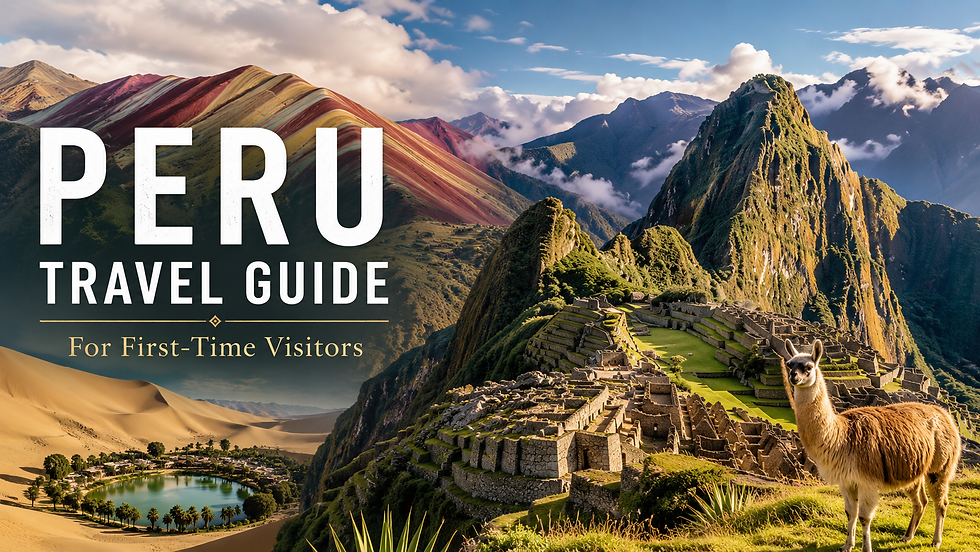
It is a small desert oasis surrounded by tall sand dunes, with a lagoon in the middle and palm trees around it. After the ocean air of Paracas, arriving in Huacachina felt like entering a completely different world.
We arrived around 3 PM, and the afternoon light made the dunes glow.
The place was small, but it had a strong travel energy. Hotels, restaurants, tour operators, and travelers surrounded the lagoon. Everyone seemed to be there for the same reason: to see the dunes, ride the buggies, try sandboarding, and watch the sunset.
For a moment, I just wanted to look around.
The contrast was beautiful — water in the middle, sand rising around it, and the sky wide open above everything.

Dune Buggy Ride and Sandboarding in Huacachina
Then came the adventure.
The dune buggy ride in Huacachina was wild.
It felt like a rollercoaster, but instead of metal tracks, we were flying over sand dunes. The buggy climbed, dipped, turned, and rushed over the desert while everyone shouted, laughed, and held on tightly.
It was exciting, chaotic, and unforgettable.
After the buggy ride, we tried sandboarding. I went belly-down on the board, held on, and let gravity do the rest.
There is a childlike joy in that moment. You stop thinking too much. You just slide, laugh, and accept that sand will probably end up everywhere.
For travelers who enjoy soft adventure, Huacachina is a great place. It does not require intense hiking or advanced skills, but it still gives you that rush of doing something different.
And then came the sunset.
Standing on the dunes as the sun began to lower was one of the most beautiful moments of the day. The sand changed color. The shadows became longer. The desert became quieter.
From the top, all I could see were waves of sand stretching into the distance.
It was hard to believe that earlier that same day, I had been on a boat watching sea lions in the Pacific.
That is what made Peru feel so powerful in my memory. In one day, I had moved from ocean wildlife to desert adventure.

Why I Could Not Stay Longer in Huacachina
As much as I wanted to spend the night in Huacachina, my route had to continue.
The next day, I was flying from Lima to Cusco. Cusco was the gateway to Machu Picchu, the place I had dreamed about for years.
So after the dune buggy ride, sandboarding, sunset, and a little time around the oasis, I boarded the Peru Hop bus back to Lima.
I remember sitting on the bus with sand still in my shoes, tired but happy.
Travel often feels like this. You arrive somewhere, fall in love with it quickly, and then leave before you are ready.
Huacachina was one of those places for me.
It was short, but it stayed with me.
Ceviche for the Night
Back in Lima, I ended the day with ceviche.
Ceviche is one of Peru’s most famous dishes, made with fresh fish marinated in citrus, usually with onion, chili, salt, and cilantro. After a long day of boats, buses, dunes, wind, and sand, that plate of ceviche felt like the perfect ending.
It tasted bright, fresh, and very Peruvian.
Food has a way of closing a travel day beautifully. You may forget the exact times, the small delays, or the little inconveniences, but you remember sitting down after a full day and realizing how much you experienced.
That night, my thoughts were already moving toward Cusco.
Machu Picchu was getting closer.
But before the mountains, Peru had already given me Lima’s historic streets, Paracas’ wildlife, Huacachina’s dunes, and a reminder that the journey itself is never just the path to the main destination.
Sometimes, the beginning is already unforgettable.

What This Lima to Huacachina Travel Diary Taught Me
This part of my Peru trip taught me that first-time travelers should not rush too quickly toward the famous landmark.
Yes, Machu Picchu was my dream. It was the reason Peru had lived in my imagination for so long.
But Lima, Paracas, and Huacachina gave the journey texture.
Lima gave me history, food, architecture, and the reality of arriving in a new continent.
Paracas gave me the ocean, wildlife, and Peru’s rugged coastal beauty.
Huacachina gave me adrenaline, desert silence, and one of the most cinematic sunsets of the trip.
Together, they made the beginning of my Peru journey feel complete.
For anyone planning a Peru trip for the first time, especially if you are nervous about traveling independently, this route is a beautiful introduction. It is practical, scenic, varied, and memorable.
You do not have to do everything perfectly. You just need enough preparation to feel grounded, enough curiosity to keep moving, and enough openness to let the country surprise you
.
Practical Tips for Lima, Paracas, and Huacachina
Bring enough water and snacks, especially before long day trips. Tourist areas can be more expensive, and you may not always want to search for a shop when you are tired.
Pack sunglasses, sunscreen, and a face covering for Huacachina. The desert wind can blow sand into your eyes and face during the buggy ride and sandboarding.
Use a secure day bag. In busy areas of Lima, keep your belongings close and avoid leaving your phone exposed.
Learn basic Spanish phrases. Even a few words can help with taxis, markets, restaurants, and directions.
Check your tour schedule carefully. If you are using a bus service or organized day trip, confirm pick-up points, return times, and whether your hotel is included.
Stay flexible. Peru can have changing conditions, delays, strikes, or route issues. Give yourself buffer time, especially before flights.
Do not treat Lima as only a transit city. It has food, architecture, ocean views, history, and culture worth experiencing.
Suggested First-Time Traveler Route
If you are planning a similar beginning to your Peru trip, a simple route could look like this:
Start in Lima and stay in Miraflores or Barranco for convenience.
Spend your first day exploring Miraflores, Larcomar, and Lima’s historic center.
Take a full-day trip or overnight stop to Paracas for the Ballestas Islands and coastal scenery.
Continue to Huacachina for dune buggy rides, sandboarding, and sunset over the dunes.
Return to Lima or continue onward depending on your route.
For travelers with more time, staying overnight in Paracas or Huacachina can make the journey feel less rushed. For travelers with limited time, a structured day trip can still give you a strong taste of both places.
Final Thoughts: The Beginning of My Peru Journey
My Peru journey did not begin with Machu Picchu.
It began with a late-night arrival in Lima, a tired taxi ride to Miraflores, a morning walk near the Pacific, colonial buildings in the historic center, the taste of chifa and ceviche, sea lions in Paracas, and sand dunes glowing under the Huacachina sunset.
And maybe that is what made it more meaningful.
Sometimes, the places before the dream destination prepare your heart for it.
Lima taught me to arrive slowly.
Paracas taught me to notice the unexpected.
Huacachina taught me to say yes to adventure, even when sand ends up in your shoes and your schedule is already pulling you somewhere else.
The next day, I would fly to Cusco, closer to the ancient city I had imagined since I was young.
But before the mountains, Peru had already welcomed me through the coast and the desert.
And for a first chapter, I could not have asked for anything more beautiful.
FAQs About Traveling from Lima to Huacachina
Is Lima to Huacachina worth it for first-time travelers?
Yes, especially if you want to see a different side of Peru before going to Cusco or Machu Picchu. The route gives you coastal views, wildlife, desert landscapes, and adventure in one journey.
Can you visit Paracas and Huacachina in one day?
Yes, it is possible with an organized tour or bus route, but it can be a long day. You should expect an early start and a late return if you are coming from Lima.
Is Huacachina beginner-friendly?
Yes. Huacachina is small and tourist-oriented, so it is easy to understand once you arrive. The main activities are dune buggy rides, sandboarding, walking around the lagoon, eating, relaxing, and watching the sunset.
Do I need to speak Spanish in Peru?
You can travel in Peru with basic English in many tourist areas, but Spanish is very helpful. Outside hotels, tours, and major tourist services, English may be limited. Learn simple phrases for directions, prices, food, and transport.
What should I pack for Huacachina?
Pack water, sunscreen, sunglasses, a hat, comfortable clothes, and something to protect your face from sand. If you bring a camera or phone, keep it protected because sand can get everywhere.
Is Miraflores a good place to stay in Lima?
For many first-time visitors, yes. Miraflores is popular because it has hotels, restaurants, ocean views, shops, and many traveler services. It is also a convenient base for tours and airport transfers.
Should I stay overnight in Huacachina?
If you have time, staying overnight can make the experience more relaxed. I visited as part of a route and returned to Lima because I had a flight to Cusco the next day. If I had more time, I would have loved to stay longer.